
Our History
Noosa will offically become the tenth World Surfing Reserve in 2020, following a 2017 vote by World Surfing Reserves, a division of the US-based Save The Waves Coalition.
After a two-year campaign by local surfers since the dedication of the Noosa National Surfing Reserve in March, 2015, the WSR’s 19-member Vision Council voted overwhelmingly for the Noosa submission, which was accompanied by a book and video documenting Noosa’s 60-year battle to protect its coastline from pollution and over-development, and its evolution as a world-class surfing destination.

Announcing the result, Nik Strong-Cvetich, Executive Director of Save The Waves Coalition, said: “Noosa more than deserves this honour of becoming the 10th World Surfing Reserve. The combination of diverse point breaks within a protected natural area, and the importance of surfing in the cultural fabric of the town made it an outstanding candidate as a WSR.”
When the Noosa World Surfing Reserve is finally dedicated, it will become the third Australian WSR, following in the footsteps of Sydney’s Manly Beach (2012) and the southern Gold Coast (2015). But unlike many of its predecessors, Noosa has been selected for the decades of best practice in coastal management and protection that have resulted in its international reputation as one of surfing’s natural wonders. On the same day of the announcement of the Noosa World Surfing Reserve, Punta de Lobos in Chile, an iconic surf break approved in 2013, was finally dedicated following a four-year campaign by World Surfing Reserves and its partners to buy back the coast from developers.
Said Noosa National Surfing Reserve chairperson Phil Jarratt: “While the main idea behind a World Surfing Reserve is to identify and help preserve iconic surf breaks around the world, many of the places in this small, select club have been chosen to draw attention to the underlying environmental and development threats that surround them. The classic example of this is the fight to preserve Punta de Lobos, and our joy at becoming a World Surfing Reserve is shared with our surfing brothers in Chile.
Noosa Mayor Tony Wellington, a founding member of the Noosa National Surfing Reserve committee, said: “This accreditation represents another feather in Noosa’s considerable cap. It is both a tribute to Noosa’s iconic status as a surfing mecca and also an acknowledgement of our modern history of pioneering environmental activism. Being a World Surfing Reserve will help maintain focus on protection of our coastline as well as care for marine biodiversity.”
Then-Tourism Noosa CEO Damien Massingham said that it was a wonderful accolade for Noosa to be recognised as a World Surfing Reserve: “We are thrilled that Noosa has become the newest World Surfing Reserve and credit must be given to the Noosa National Surfing Reserve committee for their commitment to achieving this status.”
Chair of the Gold Coast World Surfing Reserve, Andrew McKinnon, said: “We’re stoked that Noosa is joining Gold Coast and Manly Freshwater as the third World Surfing Reserve in Australia. A WSR gives both recognition and preservation value as a glowing example of how the community appreciates the beach and surf community.” So that’s the recent history. But how did Noosa become this “glowing example”? To answer that, we have to dig a little deeper.
When surfers discovered Nirvana
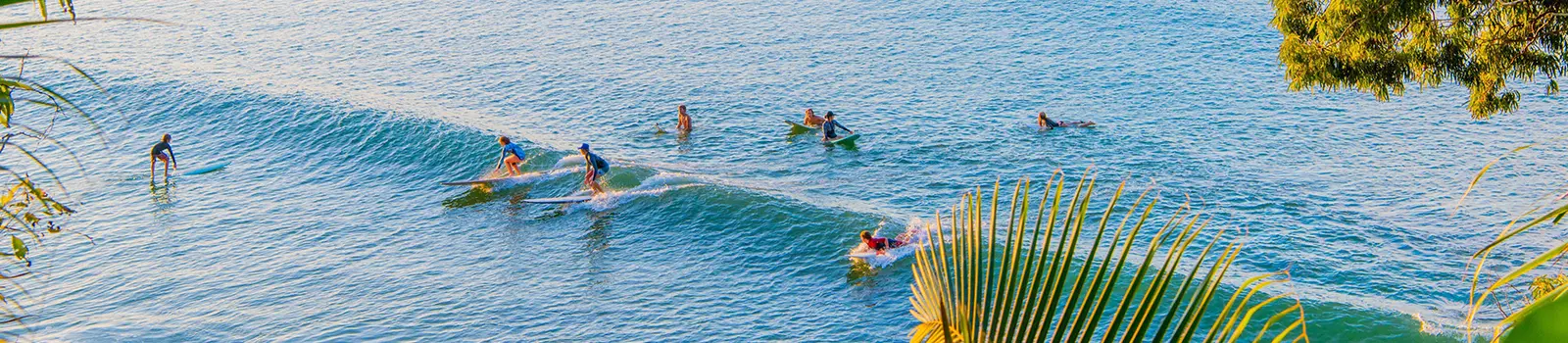
The generation of ex-servicemen who started bringing their families to Noosa in the 1950s included many keen body surfers and surf ski riders, but they mainly focused on the beach breaks of Main Beach, paying scant attention to the perfect waves rolling in along the point breaks every time an east swell combined with a south east wind. It wasn’t until a Maryborough-based lifesaver named Hayden Kenny (later to become surfing’s first ironman champion in 1966) saw balsawood Malibu surfboards in action when an American lifeguard team toured Australia in 1956 that the potential of the points was realised.
Kenny, then 20, ordered a replica of the American Malibu from Sydney surfboard builder Gordon Woods – a 10 feet six inch hollow wood veneer “okinui” weighing more than 30 pounds – and brought it down from the family farm to Noosa to try it out in late 1957. He told surf historian Stuart Scott: “I’d been to Noosa for a surf carnival, so I knew what was there, the layout of the land and the points, and how the wind affected the surf conditions, so I went there with the board. I remember that first time, walking over the sand dunes right beside the surf club, and there was First Point just going off. After that I kept going back. You only needed a two to three-feet peeling wave, and I had it absolutely to myself from 1957 to 1961.”
Hayden concedes that “there might have been others sneaking onto the points at different times” during those years, and surf club history certainly seems to point that way. Max Krogh from Gympie joined the Noosa club in the early 1950s and regularly rode a 16-foot hollow paddle board at First Point, and on small days he would paddle to the outer bays in search of waves. In 1958 Merv Cummings, also from Gympie, started leaving a huge balsa board, made by a Brisbane boatbuilder, under the clubhouse and riding it on the points. Merv later bought a cast-off Gordon Woods board from Hayden Kenny, but when he left it on the beach overnight, a storm blew it up and over the sand dune and across Hastings Street into Thatcher’s Flats. Boards were made of sterner stuff in those days, and it survived with only a few ding repairs needed.
While Noosa may have been less of a secret by the early 1960s than Hayden Kenny contends, there were never more than a few surfers in the water at any time, and they usually all knew each other…until the arrival of strange, loud man with an eye-patch and an American accent, his surfing wife and a diminutive teenager with a rascal’s grin. There is some confusion about when young Bob McTavish arrived in Noosa for the first time with Pa and Ma Bendall, the legendary Caloundra Canadians, but it was most likely early 1961, when McTavish, a Brisbane radio station panel operator, was a semi-permanent fixture in the first aid room at Caloundra Surf Club. Most mornings Pa Bendall would stop by the first aid room where the young surfer slept on a thin mattress and take him surfing. One cool morning with a strong southerly whipping up the coast, Pa announced that they were going to Noosa. Bob knew that this was a village a long way up the coast, but that was about it.
They threw Bob’s board on the roof of Pa’s Ford Ranchwagon, stopped by Harmony Court apartments to pick up Ma, and took off through the rolling hills and sugar fields to Nambour, then on to Noosa, where a steep hill dropped down to the beach to reveal a perfect point break with no one out. According to McTavish, “Ma had a shocker and Pa found it peeled a bit too fast for him, so I had these perfect little waves to myself. This was something special!”
Later in the day, McTavish persuaded Pa to tie the boards back on the car and drive further out on the point, over a couple of hills and around a few bends into a National Park where more perfect waves peeled down the rocky shore. Soon he was catching long rides from the Park through the beautiful little inside bay, and even onto First Point. McTavish was immediately hooked on Noosa.